I felt I'd like to take some time this week to talk about Plus Ultra. Besides being the name of this blog (its main and most important application), it is the national motto of Spain, and as such merits discussion.

Author Earl Rosenthal has traced the origins of this phrase back to the ancient myth of the Pillars of Hercules, which mark each side of the Strait of Gibraltar (which Spain forms one half of) and were supposedly the boundaries of the world. Upon them was inscribed Nec Plus Ultra, Latin for "nothing further beyond." These pillars, and the worlds Plus Ultra, are now symbolically intertwined on Spain's coat-of-arms, which one can see on the Spanish flag.
It was the Holy Roman Emperor Carlos V who adopted Plus Ultra as his personal motto in the sixteenth century, as a reminder not to be afraid to take risks and go "further beyond." The saying gained traction and was given as encouragement to soldiers, sailors, and the conquistadores to break the boundaries of the known world and go above and beyond their call of duty, and eventually becoming the motto of the entire Habsburg line of Spanish kings.
More interesting than the history, however, is the philosophical side of the Plus Ultra coin. Why does it fit as the Spanish motto? How does it hold its meaning today?
The arguments one could give for Plus Ultra as motto have a strong basis in history; traditionally, it has been the Spanish who have been at the cutting edge and have gone beyond what one might consider prudent or likely for them to do. Just look at the conquest of the New World; the flat earth fear is a myth, but it still took a lot of guts and courage to sail off without knowing where
 you're going or how far it will be to get there. The Portuguese explorers that discovered sea routes to Asia had it easy; all they had to do was follow the African coastline and keep it in sight. The Spanish were sailing straight into an ocean that was uncharted and altogether unknown.
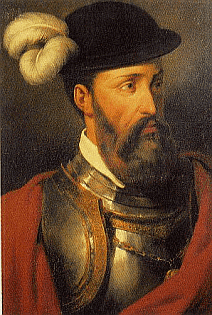
More than discovering the New World, however, it is the audacity of the conquistadores that is most astounding. Putting aside the moral debate over their bloody conquests, let us look at the courage that it took them to achieve what they did. Look at Francisco Pizarro, for example: deep in the South American continent with a hundred-odd men, with no means of resupply or communication with other Spaniards, going into a total unknown. Sure, steel weapons and horses and his European diseases were stacked in his favor; but when he came upon the Incan emperor, with his 80.000 man army, instead of cutting and running Pizarro decided to attack. He seized the emperor as his hostage and fought off the thousands of Incans in a bloodbath at Cajamarca, and eventually conquered the entire Incan Empire. Again putting the moral question aside, this was a brilliant and courageous act on his part. No one would expect a hundred Spaniards to conquer the dozens of thousands of Incas, and yet they did. They went further beyond any other conquest before them, more so than even Hernán Cortés did.
But how does this continue to apply to modern Spain? We are not, after all, engaged in any more sweeping wars of conquest nowadays (or wars at all, really). Plus Ultra has gone underground. Instead of being at the forefront of national actions, one can now see it reflected
 more in the people. The peaceful, determined, and phenomenally successful transition to a stable democracy that followed the end of dictator Francisco Franco's reign displayed this. Spain's economy displays this. At a time when many European economies are stagnant or even in decline, Spain's economy is showing a steady growth rate of 3% annually. Since the utter ruin of post-Civil War Spain is rising a renewed, invigorated economic force that is starting to stand on its own two feet. Despite fears that a housing "bubble" is forming, Spain's economy will likely continue to exhibit growth due to developments in other sectors, perhaps merely tempered somewhat by a cooling down of the real estate market. The Spanish people are consistently seeking ways to do more with their lives, and the economic growth reflects this. Like the myriad and iconic construction cranes that dot the Spanish landscape, Spaniards are standing up and building a better future out of what could have been a bleak outlook. Spanish vision, tenacity, and perseverance have overcome many obstacles in the past and will hopefully continue to do so in the future. That is Plus Ultra.

No comments:
Post a Comment